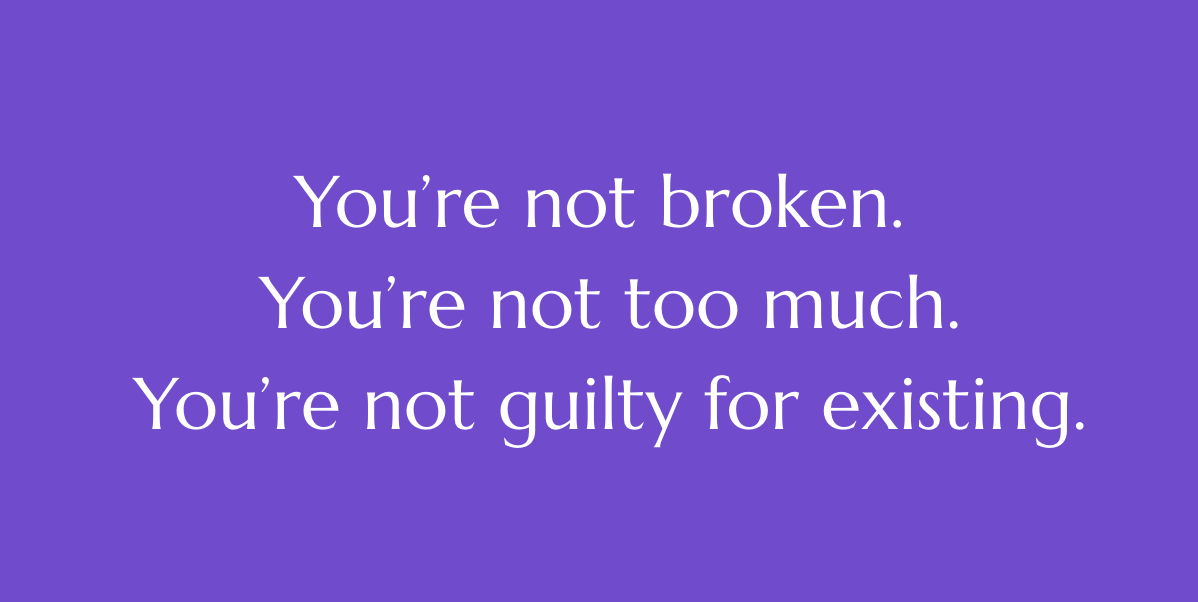
If you’ve ever felt guilty just for existing differently, or if your body tightens the moment you say “no” to someone, this is for you.
Many of us — especially those of us who are neurodivergent and have survived trauma — live in a near-constant soup of ugh, I did something wrong or ugh, I am something wrong.
But here’s the thing: that’s not always guilt.
A lot of the time? It’s shame dressed up in guilt’s clothes.
The ND + Trauma Combo
When your brain is wired differently and you grew up being misunderstood, punished for your needs, or made to feel like your feelings were “too much” — shame doesn’t just sneak in. It moves in and decorates the place.
You might grow up thinking:
-
“If I was just better / quieter / easier, they’d love me.”
-
“I can’t trust myself — I always mess things up.”
-
“I feel guilty for needing time, space, rest, support…”
Spoiler: you don’t need to feel guilty for existing as you are.
Let’s Break It Down
Guilt says: “I did something wrong.”
It’s tied to specific actions — things like forgetting a birthday, snapping at someone, or dropping the ball.
It’s uncomfortable, but it can actually guide you back to your values.
Guilt says: “Hey, that didn’t sit right. Let’s repair that.”
Shame says: “I AM something wrong.”
It’s not about what you did — it’s about who you are.
It’s heavy. Sticky. It often lives in your body, not your thoughts. And it usually comes from years of being told — directly or indirectly — that you were a problem.
A Bit of My Own Story
When I was a pre-teen, I told my mother I felt guilty.
Her response? She took me to church.
Apparently, if I felt guilt, I must have something I needed to confess.
At the time, I didn’t have the words for it. But looking back, I can say:
That wasn’t guilt. That was shame.
The kind that forms when you learn early on that certain emotions, needs, or truths are morally wrong.
I didn’t need confession. I needed compassion. I needed someone to say, “Hey, you’re not broken — you’re human.”
How It Shows Up Now (Maybe For You Too)
-
You say no and instantly spiral into self-doubt.
-
You need accommodations or rest and feel like a burden.
-
You mask in every social setting, then crash and feel fake.
-
You apologize when you haven’t actually done anything wrong.
These aren’t character flaws. They’re survival strategies.
They’re what happen when shame teaches you that being yourself is unsafe.
Reclaiming the Difference
When we can name what’s really happening — “This is shame, not guilt” — we can start to move differently.
Guilt invites repair.
Shame demands hiding.
The work isn’t just about “feeling better” — it’s about recognizing that a lot of the weight you carry was never yours to begin with.
What You Deserve to Know
You are not too much.
You are not a mistake.
You are not guilty for needing time, space, quiet, movement, stimulation, accommodations, honesty, or softness.
You’re not broken.
You’re just carrying a story someone else handed you — and you’re allowed to put it down.
If this resonates, maybe keep this close — here’s a free printable for you. Let it remind you that there’s nothing wrong with how you feel. Your nervous system has just been trying to protect you in a world that didn’t always know how to hold you.
Healing starts with clarity. You deserve that clarity.
And you sure as hell don’t need confession. You need care.